
Florida Chapter 119 and Collier County Public Records
Florida's public-records law starts from a position of openness. Chapter 119 of the Florida Statutes declares that state, county, and municipal records are open for personal inspection and copying by any person. The law applies to every agency, including Collier County and its offices. An agency that denies access must cite the specific statutory exemption that permits the denial. Partial exemptions require redacting only the protected portion rather than withholding the entire record. Florida has no minimum age or citizenship requirement for making a public-records request, and requesters are not required to explain why they want a record.
The constitutional basis sits in Article I, Section 24 of the Florida Constitution, which makes public records and public meetings access a state right subject only to exemptions the legislature creates. Florida Statute 119.01 states the public-policy declaration. Florida Statute 119.011 provides definitions, including what counts as a "public record" and who qualifies as a custodian or agency. Taken together, these provisions mean that Collier County records maintained by the Clerk, the Sheriff, or county agencies are public by default unless a specific exemption applies. The burden is on the government to justify withholding, not on the person asking.
Court records in Collier County carry an additional layer of rules. Florida Rule of General Practice and Judicial Administration 2.420 governs public access to judicial-branch records and sets the process for confidentiality designations. The Florida courts statewide security matrix determines which court-case documents are available to the public through the internet versus only at a courthouse terminal. These rules sit on top of, not instead of, Chapter 119. Both frameworks shape what a person can get and how quickly.
The Florida Legislature page for Chapter 119 is the official source for the full text of the public-records statutes, including all current exemptions. The page is updated when the legislature amends the law, so it reflects current law rather than a printed summary.
The Florida State Courts System electronic records access page explains the security matrix and how it governs internet access to court files across all sixty-seven counties. Collier County court records follow this statewide framework, not a local policy set independently by the Clerk.
The Florida State Courts System electronic records access page describes the security matrix used statewide to govern which court documents are publicly viewable online.
The security matrix applies to all sixty-seven Florida counties, including Collier, and controls what internet users can view versus what requires a courthouse visit or formal public-records request.
Collier County Public Records Statutes at a Glance
Five statutes cover the core rules for requesting and enforcing public-records rights in Collier County. Each one is linked to the official Florida Legislature text.
| Statute | Plain-English Summary |
|---|---|
| F.S. 119.01 | Declares that all state and local records are open to inspection and copying by any person; openness is the default. |
| F.S. 119.07 | Requires custodians to allow inspection at a reasonable time, respond in good faith, redact exempt parts rather than withhold entire records, and cite the exemption relied on. |
| F.S. 119.0714 | Covers court files, court records, and Official Records specifically; authorizes removal of certain protected images from public websites. |
| F.S. 119.10 | Sets penalties for custodians who knowingly refuse to allow inspection or copying in violation of Chapter 119. |
| F.S. 119.12 | Allows a court to award attorney fees and costs to a person who prevails in a civil suit after an agency unlawfully denies access to a public record. |
Note: F.S. 119.11 also provides an accelerated hearing process for public-records enforcement, letting a requester get a court ruling faster than in ordinary civil litigation.
Florida Legislature Chapter 119 displays the full public-records law, including all exemptions, as currently in force.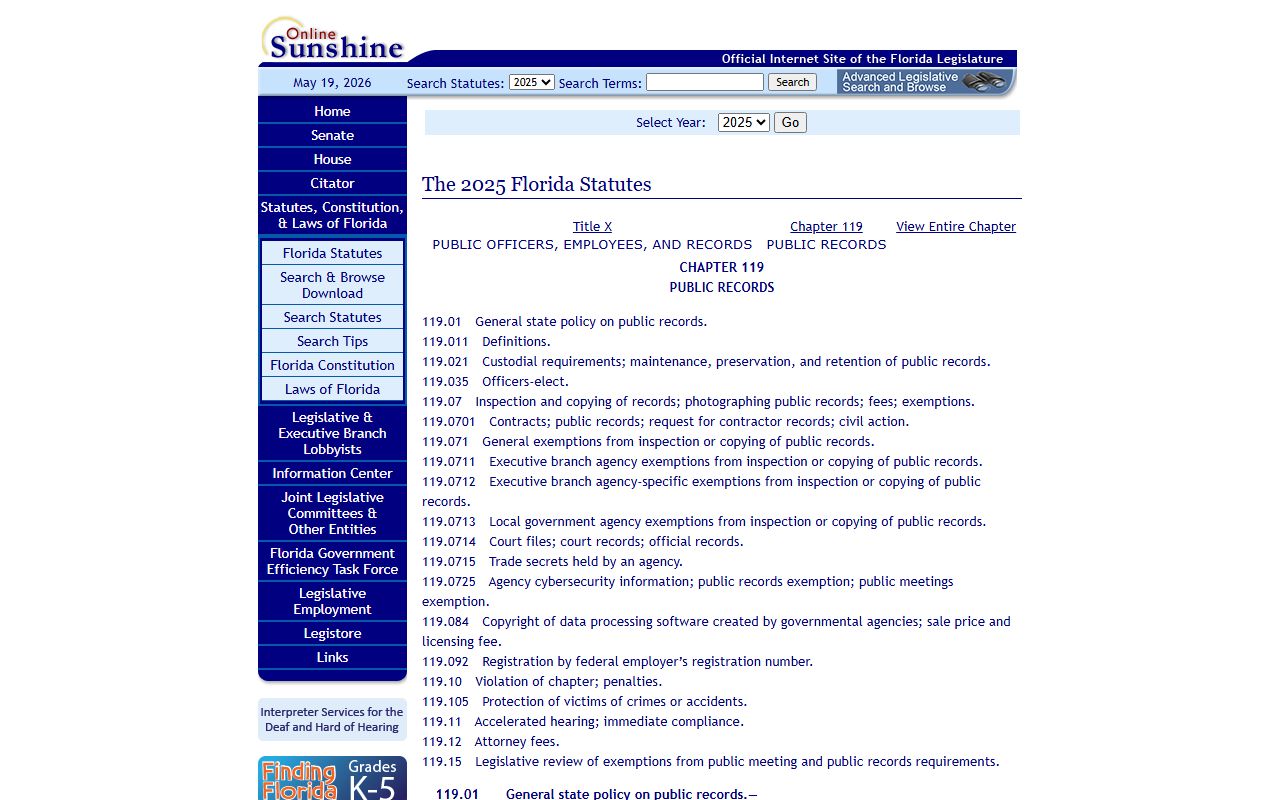
Chapter 119 is the starting point for any Collier County public-records request; the text covers inspection rights, copying fees, exemptions, enforcement, and penalties in a single chapter.
What Collier County Public Records the Clerk Maintains
The Collier County Clerk of the Circuit Court and Comptroller, Crystal K. Kinzel, runs a unified office that goes well beyond court cases. The Clerk handles every category listed below and provides public search access to most of them through online systems. Court records are searched through ShowCase Web at cms.collierclerk.com/showcaseweb/. Official Records such as deeds, mortgages, and liens are searched through COR Access at cor.collierclerk.com/coraccess/. These are two separate systems with different indexes and different document types. A deed recorded in Official Records does not appear in the court case portal, and a divorce judgment in the court portal does not appear in the Official Records deed index.
- Court records: civil, criminal, family, probate, traffic, guardianship, mental health, delinquency, and dependency case files
- Official Records: deeds, mortgages, liens, injunctions, recorded marriage licenses, and other instruments recorded under Chapter 28
- Marriage licenses: issued and recorded by the Clerk's Recording Department
- Board records: minutes and official records of the Board of County Commissioners
- Lobbyist records: filings required under county ordinance
- Value Adjustment Board records: property assessment appeals and hearing results
- Zoning maps: recorded zoning documents available through the Clerk's records system
- Foreclosure sales: scheduled sale listings and sale records
- Tax deed sales: auction and tax-deed recording functions
- Financial records: as county Comptroller, the Clerk also maintains budget and audit-related public records
The Sheriff's Office maintains its own records, including arrest data, active warrants, and law-enforcement investigative records. Sheriff public records are separate from Clerk records. The Sheriff's public arrest-search database at colliersheriff.org is provided as a courtesy but does not replace a formal public-records request for agency files. The Sheriff's page states explicitly that the database should not substitute for filing a request under Florida Statute 119 when complete and official records are needed. For final court case disposition, always use the Clerk's ShowCase portal rather than arrest data alone.
Official Records vs Court Records vs Public Records Request
Many people use these terms interchangeably, but they refer to three distinct things in Collier County. Knowing which one you need saves time. The comparison below covers custodian, what is covered, where to search, and applicable fees.
| Feature | Official Records | Court Records | Public Records Request |
|---|---|---|---|
| Custodian | Collier Clerk (Recording Dept.) | Collier Clerk (Courts Dept.) | Varies by record type and agency (Clerk, Sheriff, County) |
| What is covered | Deeds, mortgages, liens, recorded marriage licenses, injunctions, and recorded instruments | Case dockets, charges, sentences, judgments, and filed documents in civil, criminal, family, probate, and traffic cases | Any public record held by any county agency, not otherwise exempt |
| Search portal | cor.collierclerk.com/coraccess/ | cms.collierclerk.com/showcaseweb/ | Contact Clerk's Public Records Coordinator or relevant agency directly |
| Online viewing fee | Free to view index; copy fees for downloaded/mailed documents | Free for public view; no fee to view online case records | Depends on record type, format, and extent of search required |
| Typical use | Real estate research, lien checks, recorded marriage verification | Case status, docket history, party lookup, court dates | Records not in either online portal; internal reports, contracts, emails, agency communications |
If you are looking for a deed or mortgage on a piece of land, start at the Official Records portal. If you need a court case number or docket, start at ShowCase. If you need something not in either online system, such as internal agency emails, budget contracts, or law-enforcement reports, file a written public-records request with the right agency.
Collier County Public Records Coordinator
The Clerk's designated custodian for public-records requests is Renata Robbins, Public Records Coordinator. Her role is to receive, track, and respond to requests that fall under Chapter 119 for records held by the Clerk's office. Requesters who are not sure which department holds the record they need can direct the request to this office, and the Coordinator will route it appropriately within the Clerk's structure.
Public Records Coordinator: Renata Robbins, Custodian of Public Records
3315 Tamiami Trail East, Suite 102
Naples, FL 34112
Phone: (239) 252-2646
Hours: Monday through Friday, 8:00 a.m. to 5:00 p.m.
The Clerk's website carries an important email-address notice required by Florida law. If a person does not want their email address released in response to a future public-records request, they should contact the Clerk's office by phone or in writing rather than by email. An email sent to the Clerk's office is itself a public record. The email address in that message can be disclosed if someone later requests it. Using phone or mail avoids creating a record that includes the requester's email address.
Note: Requests for records held by the Collier County Sheriff's Office, county constitutional offices, or county government departments should go directly to those agencies, not to the Clerk's Coordinator. Each agency has its own public-records custodian under Chapter 119.
How to File a Public Records Request in Collier County
Florida law does not require a specific form for a public-records request. A request can be made in person, by phone, by mail, or by email. The Clerk's website provides a "Request Public Records" navigation item and a contact workflow for online and email submissions. The steps below apply to requests directed to the Collier Clerk's office. Requests to the Sheriff or county government follow the same general process but go to those agencies separately.
- Identify the right custodian. Court records and Official Records go to the Collier Clerk at Suite 102. Arrest records, warrant information, or law-enforcement files go to the Collier County Sheriff's Office. County government contracts, budget documents, or agency emails go to the relevant county department. The Public Records Coordinator can help route requests within the Clerk's functions.
- Describe the records you want. Be specific enough that the agency can locate the records without guessing. Include case numbers, date ranges, names of parties, document types, or other identifiers you know. Vague requests can be returned for clarification, which delays the response.
- Choose your submission method. Deliver the request in person to Suite 102 at the Naples government complex, mail it to 3315 Tamiami Trail East, Suite 102, Naples, FL 34112, use the online contact form or email link from the Clerk's website, or call (239) 252-2646. In-person or written requests create a clearer paper trail if there is a dispute later.
- Acknowledge the email-address notice. If you use email to submit your request, your email address becomes part of the public record. If you want to keep your email address private, use mail or phone instead.
- Wait for the agency response. Florida law requires a good-faith response in a reasonable time. That does not mean instant. For large or complex requests, the agency may need time to locate, review, and redact records. The Clerk can ask for reasonable time extensions when requests are extensive. If you have not heard back within a week or two on a simple request, follow up.
- Review any cost estimate before records are produced. If the request will take more than a minimal amount of staff time, the agency may provide an estimate before producing records. You can narrow the request to reduce costs, pay the estimate and proceed, or decide not to proceed. Payment is due before the agency is required to produce copies.
- Receive the records. Electronic records are often sent by email or download link at no cost. Paper copies carry per-page copy fees. Certified copies carry additional certification fees. For records available in the online portals, the agency may direct you there rather than reproducing them manually.
- Know your options if access is denied. If the agency denies the request, it must cite the specific statutory exemption. You can challenge the denial through a civil action in circuit court, and under F.S. 119.12, a court may award attorney fees if the agency unlawfully refused access. The Florida Attorney General's Government-in-the-Sunshine Manual is a public-domain resource for understanding your rights, though it is not a substitute for legal advice in contested situations.
Collier County Public Records Request: What to Include
No official form is required, but including the following information in your request makes processing faster and reduces back-and-forth. A complete request is less likely to be returned for clarification and less likely to generate a broader cost estimate than you expect. The Clerk's office identifies four core elements that should appear in any written request.
| Field | Required by Law | Notes |
|---|---|---|
| Requester contact information | Not strictly required | Providing name, phone number, and preferred contact method lets the agency reach you for cost estimates or clarifying questions. Withholding identity is allowed under Florida law, but the agency cannot send records if it has no way to reach you. |
| Description of the records | Yes (functionally required) | Include case numbers, dates, party names, document types, and any other identifiers you know. Broad or vague descriptions may be returned for clarification before the agency begins searching. |
| Preferred delivery method | No | Specify whether you want electronic delivery (email, download link), paper copies by mail, or in-person pickup. Electronic delivery often avoids per-page copy fees for records already in digital form. |
| Fee and payment arrangement | No (but needed before records are produced) | If you have a budget limit, state it. The agency will inform you if the estimated cost exceeds it before producing records. Payment is typically due before copies are sent or released. |
If you are asking for a document that is already available in the Official Records portal or ShowCase, the agency may direct you there rather than reproduce it. Checking both online systems before submitting a written request can save time and cost for the kinds of records those portals already make freely available.
Collier County Public Records Fees
Florida law governs the fees an agency can charge for public records. Standard copy fees are set by statute, not by individual agency preference. A special service charge may apply when a request requires extensive use of information technology, clerical labor, or supervisory review beyond the ordinary staff time needed to locate and copy records. That charge must be reasonable and based on the actual cost of producing the records. The Clerk's master fee page at collierclerk.com/fees/ links to division-specific fee schedules for court filing, recording, marriage, probate, traffic, and family law.
| Item | Fee / Rate |
|---|---|
| Viewing court cases online | No charge |
| Standard paper copy (one-sided, letter/legal size), per page | Set by F.S. 119.07 (typically $0.15 per page for one-sided; $0.20 for two-sided) |
| Special service charge (extensive search/tech resources) | Actual cost; agency must inform requester before proceeding |
| Marriage certified copy (additional copies) | $3.00 per copy |
| Marriage license (standard) | $86.00 |
| Dissolution of marriage filing | $408.00 |
| Circuit civil general action filing | $400.00 |
| Probate formal administration / guardianship | $400.00 |
| Summons issuance | $10.00 |
| In-person card processing | 3.5% of total |
| Online card processing | 4.0% of total |
Filing fees listed above are not public-records copy fees. They are the fees the Clerk charges to file a case or record a document. Copy fees for public-records requests are a separate calculation based on the number of pages and any special service charge. For electronic records produced in an existing digital format with no special processing, there is generally no charge beyond what staff time the production requires under the statutory framework.
Exempt Records and Redaction in Collier County
Florida law creates many specific exemptions to the general rule of openness. An exemption means the record or portion of it may be withheld or must be redacted before release. When only part of a record is exempt, the agency must redact that portion and release the rest. Withholding an entire record when only one field is exempt violates Chapter 119. Categories that are commonly exempt or partially restricted in Collier County include the following.
- Juvenile delinquency and dependency records: Delinquency and Dependency are portal case categories in ShowCase, but public internet access is restricted by Florida juvenile statutes and court rules. A search may return no results even when a matter exists.
- Adoption records: Court records for adoption are confidential except to authorized persons or by court order under F.S. 63.162.
- Mental health and substance abuse records: Baker Act and Marchman Act court records are strongly restricted. Marchman Act petitions, orders, and related records are confidential under F.S. 397.6760.
- Victim information: Crime-victim identifying and location information is protected in court and law-enforcement records under Marsy's Law and related statutes.
- Sealed and expunged criminal records: After a court order under F.S. 943.0585 or F.S. 943.059, criminal history records are restricted from ordinary public access. Sealed records remain in existence for limited authorized uses; expunged records are generally destroyed or removed.
- Active law-enforcement investigative records: Records in an open investigation may be exempt while the investigation is active under Chapter 119 exemptions.
- Social Security numbers, financial account numbers, and medical information: Redacted under statutes and court rules including Florida Rule 2.425, which requires filers to minimize sensitive identifying information in documents submitted to the court.
The Official Records system carries a specific Chapter 119 notice allowing affected persons to request removal of exempt information or images from the public website. This applies to military discharge records, death certificates, and court files governed by family, juvenile, or probate rules. Important: grantor, grantee, and party names listed in the Official Records index under F.S. 28.222(2) are not removed from the index even when a protected image or specific exempt field is removed from the public website. The name index remains public; only the document image or the protected field can be removed.
Probate and guardianship case images may be restricted even when the case index appears in ShowCase. Some family-law documents are also not available for internet viewing under the security matrix and Rule 2.420, even if the case docket shows the filing exists. This does not mean the records are sealed; it means they require an in-person request or authorized access at a courthouse terminal.
Collier County Sheriff Public Records
Sheriff Kevin Rambosk's office maintains its own set of public records separate from the Clerk. The Sheriff's arrest-search database covers arrests made on or after January 1, 2016, and all currently active warrants. The database is provided as a public courtesy, but the Sheriff's website is explicit: the database should not substitute for a formal public-records request when accurate and complete agency records are needed. The Sheriff's records include arrest reports, booking information, warrant records, and related law-enforcement files. These are not the same as the Clerk's court records.
For complete law-enforcement records, contact the Sheriff's Central Records Bureau at 239-252-0637 for arrest records, or the Fugitive Warrants Bureau at 239-252-9655 for warrant information. Formal public-records requests for Sheriff agency records go to the Sheriff's Office directly, not to the Clerk's Public Records Coordinator. The Sheriff's Office is a separate constitutional office under Florida law and operates its own public-records custodian function.
The Sheriff's fraud alert is worth repeating here: the Collier County Sheriff's Office never solicits bond or fine payments, and bond cannot be paid by phone. Any call demanding phone payment of a bond or fine in connection with a warrant or arrest should be treated as suspicious. Verify through official Sheriff and Clerk phone numbers only.
Collier County Public Records Inspection Rights Under F.S. 119.07
Florida Statute 119.07 is the procedural core of the public-records law. It sets out what custodians must do when a request comes in. Custodians must permit inspection at reasonable times and under reasonable conditions. They must respond in good faith. They must redact exempt portions and release the rest. When denying access to any portion, they must identify the specific exemption that allows the denial. The law does not set a specific number of days for a response but requires a good-faith response "as soon as practicable," which courts have interpreted to mean promptly and without unnecessary delay.
Florida Statute 119.07 sets out the inspection and copying requirements that apply to every public-records request in Collier County.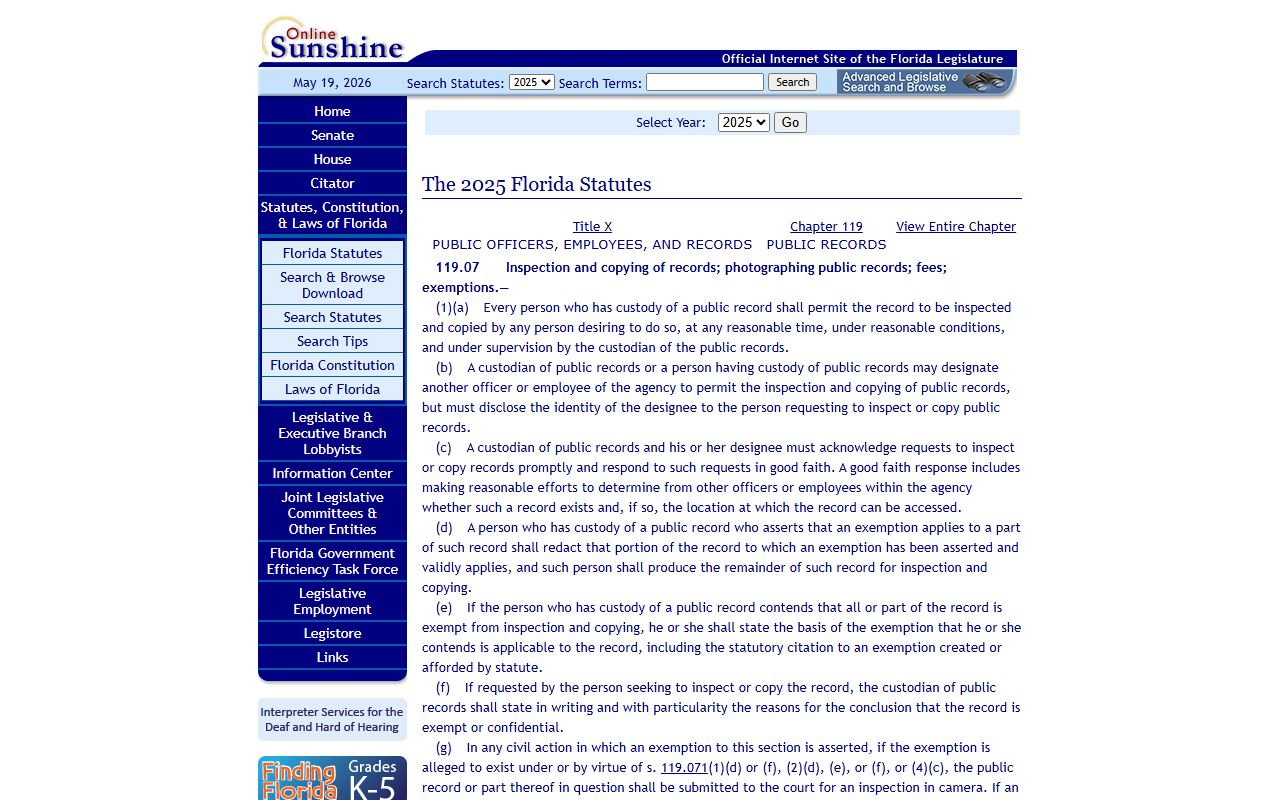
The statute applies to the Clerk, the Sheriff, county offices, and any other agency holding records that fall under Chapter 119's definition of public records in Collier County.
If a custodian refuses access without citing a valid exemption, the requester may file a civil action in circuit court. Under F.S. 119.11, the court can give the case an accelerated hearing so the dispute is resolved quickly rather than waiting years in the ordinary civil queue. If the requester wins, F.S. 119.12 authorizes the court to award attorney fees and costs. That fee-shifting provision is a meaningful deterrent against frivolous denials. Agencies that wrongly refuse access face the real cost of covering the requester's legal bills if a court finds the denial was unlawful.