
Collier County Sheriff Arrest Records Search
The Collier County Sheriff's Office runs a public arrest and warrant search at colliersheriff.org. Before you reach the search form, you must accept a terms-and-conditions screen at the Sheriff's acceptance page. Clicking "I DO NOT ACCEPT" exits the tool. Once accepted, the search form at arrestsearch/Search.aspx loads with all available fields. The database covers arrests made on or after January 1, 2016, and all currently active warrants with no date restriction. Results are capped at 100 hits per query.
The Sheriff states the database is provided as a courtesy and should not replace a formal public-records request under Florida Statute 119. Arrest information reflects circumstances at the time of booking, not a finding of guilt, acquittal, or final disposition. To find what happened in court, check the Clerk's ShowCase Web court records portal after reviewing the arrest data here.
The Today's Arrests report lists bookings from the current report date. On May 18, 2026, the daily report showed 17 matches. Some profiles were marked IN CUSTODY; others showed a BONDED status with a date.
A lead-in image: the Sheriff's terms-and-conditions page at arrestsearch/Default.aspx is the required entry point before any search.
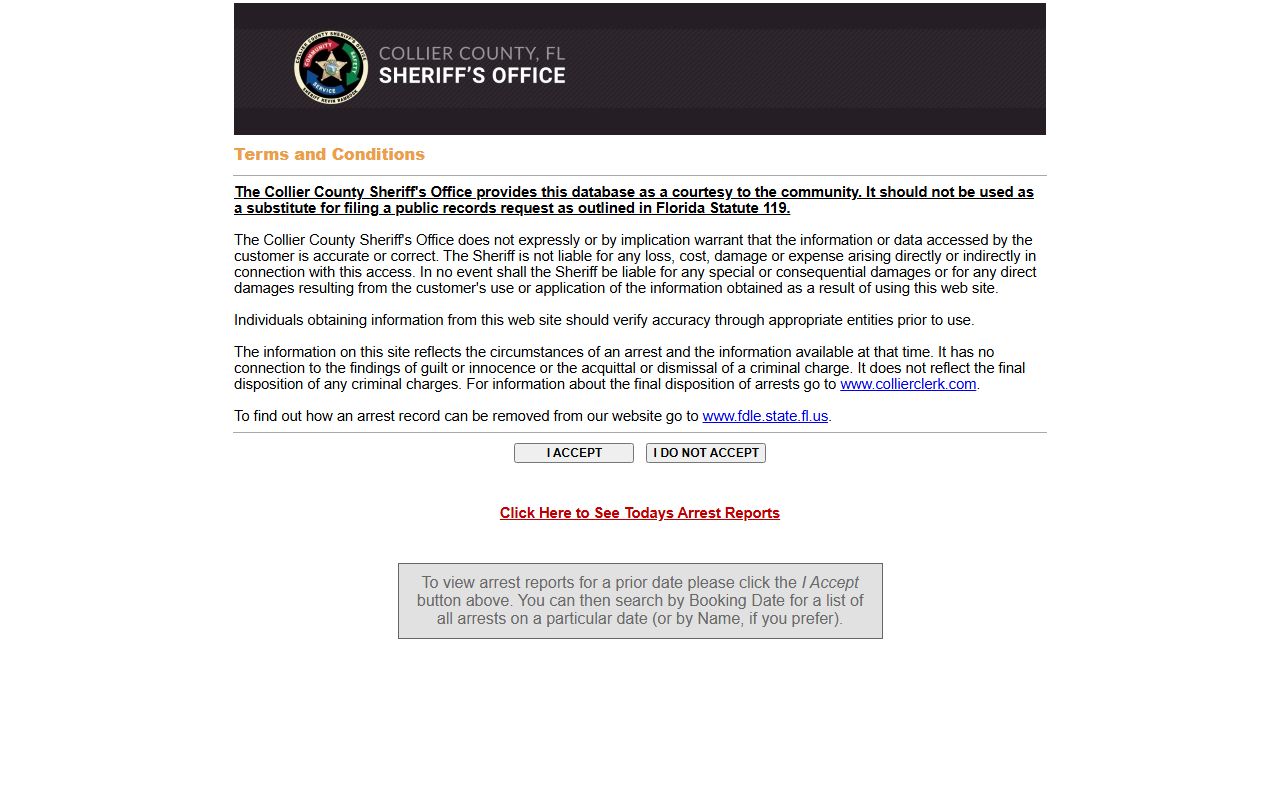
After clicking "I ACCEPT" on this screen, the search form loads with all fields active, including name, date of birth, booking date, and type selection.
Collier County Arrest Search Fields and Limits
The Sheriff's search form offers seven fields. Last-name searches are exact-match only. First-name searches support a wildcard asterisk at the end for starts-with matching, such as "Mar*" to return Marcus, Maria, and Mario. Dates must use MM/DD/YYYY format. The Type dropdown lets you focus on arrests only, active warrants only, or both at once.
| Field Label | Type | Format / Notes |
|---|---|---|
| Last Name | Text | Exact match only; no wildcard at last name |
| First Name | Text | Use * at end for starts-with logic (e.g., "Jo*") |
| Date of Birth | Date | MM/DD/YYYY; helps narrow common names |
| Booking Date | Date | MM/DD/YYYY; returns all arrests booked on that date |
| Booking Number | Text | Direct lookup if number is known |
| Type | Dropdown | BOTH, ARREST, or WARRANT |
| In Custody Only | Checkbox | Limits results to currently held individuals |
Note: Arrest records are limited to bookings from 1/1/2016 forward; all active warrants are searched with no date cutoff. Maximum results per query: 100.
The search form at arrestsearch/Search.aspx is shown below after terms acceptance.
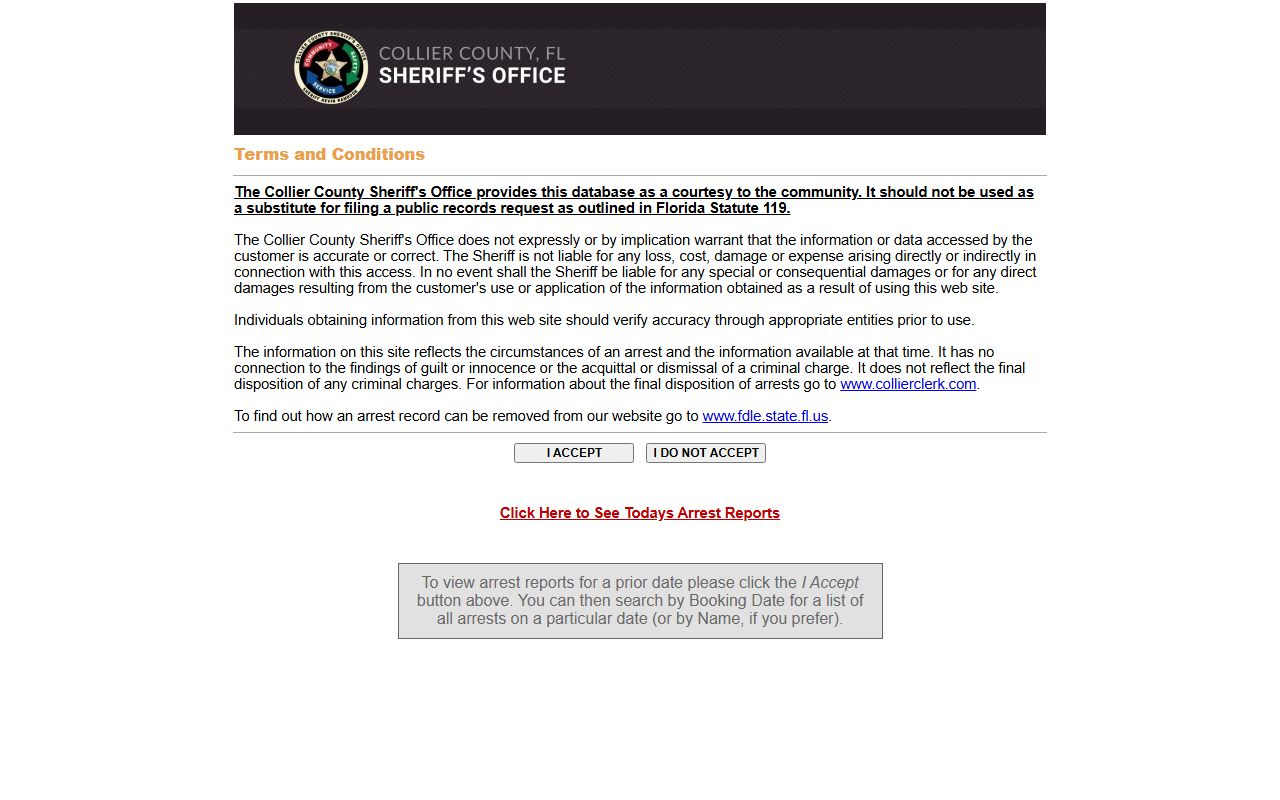
This form, accessible only after accepting the Sheriff's terms, gives you access to arrest records from 2016 forward and all active Collier County warrants.
How to Search Collier County Sheriff Arrest Records
The process takes five steps. Use the search controls noted above to get the best results. If you know both the last name and date of birth, enter both to cut down on false matches.
- Go to the Sheriff's Arrest and Warrant Search page on the Collier County Sheriff's Office website.
- Click "I ACCEPT" on the terms-and-conditions screen. Clicking "I DO NOT ACCEPT" exits the tool without reaching the search form.
- Enter the person's last name exactly as it appears. Optionally add first name, date of birth (MM/DD/YYYY), or booking date to narrow results. For warrant-only searches, set the Type dropdown to WARRANT.
- Click Search. Results cap at 100 hits. If you see no results, try varying the first-name spelling or check the booking date range. Last-name input is case-insensitive but must be exact.
- Open a profile to see booking details, charges, court dates, and bond status. For the final court outcome, note the case number and search it in the Clerk's ShowCase Web.
For questions about an arrest, call the Central Records Bureau at 239-252-0637. For warrant questions, call the Fugitive Warrants Bureau at 239-252-9655. Jail custody questions go to the Naples Jail Center at 239-252-9504. Do not pay any bond or fine over the phone. The Sheriff's fraud alert is clear: CCSO never solicits bond or fine payments by phone.
Collier County Arrest Profile Field Inventory
Each public arrest profile in the Sheriff's system shows a consistent set of fields. The Today's Arrests report at arrestsearch/Report.aspx uses a text-and-table layout rather than a card-based UI. Fields observed during inspection of the May 18, 2026 report are listed below.
| Field | What It Shows |
|---|---|
| Name | Full name of the arrested individual |
| Date of Birth | DOB as recorded at booking |
| Residence | Address entered at booking; may contain abbreviations or data-entry variations |
| A# | Sheriff's internal arrestee identifier |
| PIN | Personal identification number assigned at booking |
| Race | Race classification recorded at booking |
| Sex | Sex recorded at booking |
| Height | Height in feet and inches |
| Weight | Weight in pounds |
| Hair Color | Hair color at time of arrest |
| Eye Color | Eye color at time of arrest |
| Booking Date | Date the individual was formally booked into the jail system |
| Booking Number | Unique booking identifier for this jail entry |
| Agency | Arresting agency; observed values include CSO, NPD, MPD |
| Age at Arrest | Age calculated from DOB and booking date |
| IN CUSTODY flag | Appears when the individual is still held; absent when released or bonded |
| Charges (table) | Charged date, count, offense description, Hold For agency, case number, court date |
| Bond Status | May show "No information available" or a dated "BONDED" entry |
Mugshot images were not visible in the text-extraction of the public report. Holding pod and magistrate information were also not displayed in the inspected public profiles. If any of these fields matter for your purpose, call the Naples Jail Center directly.
Collier County Charges vs. Convictions
A charge and a conviction are not the same thing. The Sheriff's arrest data shows charges as recorded at booking. A charge reflects a law enforcement determination of probable cause, not a finding of guilt. Conviction requires a court process. The Sheriff is explicit about this: arrest information is not connected to findings of guilt, innocence, acquittal, dismissal, or final disposition.
The Clerk's ShowCase Web court case portal is the source for what actually happened in court. The Charges tab in ShowCase shows statute number, offense description, offense level, plea date, court action, and prosecutor action. The Sentences tab shows whether any sentence was imposed. A pending status in ShowCase means the case is still open.
| Charge | Conviction | |
|---|---|---|
| Source | Sheriff's Office / arresting agency | Clerk of Court / ShowCase court record |
| Meaning | Probable cause existed; formal accusation filed | Court adjudication of guilt or accepted plea |
| When It Appears | At booking, before any court process | After disposition: verdict, plea, or adjudication withheld |
| How to Confirm | Sheriff arrest portal, Clerk Charges tab | Clerk ShowCase Charges and Sentences tabs; Disposition Date field |
| Public Record | Yes, unless case sealed or juvenile | Yes, unless adjudication withheld and record sealed |
Note: Cases involving charges from DUI, reckless driving, driving while license suspended, or hit and run may appear as both criminal records and in the traffic-court system. See Collier County traffic court records for the overlap with criminal traffic charges.
Collier County Criminal Court Records in ShowCase
The Clerk's ShowCase Web portal covers felony, misdemeanor, criminal traffic, non-reporting criminal, and related court categories. Public access is free and does not require registration. Registered users may see additional content based on their role under Florida's statewide Security Matrix.
Criminal case types available in ShowCase include Felony, Misdemeanor, Criminal Traffic, Probation, and Non-Reporting Criminal. The Court Type dropdown also lists County Ordinance and Municipal Ordinance for local-ordinance matters. A sample case inspected on May 19, 2026 carried case number 11-2026-MM-000744-AXXX-01, showing a misdemeanor (MM) matter in pending status with associated docket, charge, and fee tabs. Docket entries observed in that case included a Booking Sheet, First Appearance Hearing, Arraignment setting, Jail Arrest Card, and Certificate of Compliance with the Jessica Lunsford Act.
The Charges tab in ShowCase shows statute number, count, description, offense date, offense level, plea date, court action, disposition date, and prosecutor action. The Sentences tab shows sentence details when imposed. The Fees tab shows amounts owed, payments made, and any payment plan. To search by case number, a short Collier-style number like 26MM000744 also resolves to the full formatted case number in the portal. For DUI and traffic-related criminal matters, review traffic court records alongside the main criminal search.
Criminal fees charged through the Clerk include a $50 public defender application fee, a $220 standard misdemeanor assessment, and a $415 standard felony assessment. These are Clerk-assessed amounts separate from fines, court costs, or bond.
Collier County Sheriff Criminal Records Contacts
Three Sheriff units handle the main public questions about arrest records, warrants, and jail custody. Contact them directly for matters that the online portal does not resolve.
Collier County Sheriff's Office
3319 Tamiami Trail East, Naples, FL 34112
239-252-0637
Function: Arrest records inquiries
Collier County Sheriff's Office
3319 Tamiami Trail East, Naples, FL 34112
239-252-9655
Function: Active warrant questions and fugitive-related inquiries
3347 Tamiami Trail East, Naples, FL 34112
239-252-9504
Function: Custody status, booking inquiries, jail-related questions
Warrants go through a different unit than general arrest records. If you have a question about whether someone is actively wanted, the Fugitive Warrants Bureau at 239-252-9655 is the right call. For full warrant search guidance, see Collier County warrant records.
Sealed vs. Expunged Collier County Criminal Records
Florida law gives qualifying individuals two forms of relief from public criminal record access: sealing under F.S. 943.059 and expunction under F.S. 943.0585. They serve different purposes and have different eligibility standards. Most applicants in Collier County must go through the Florida Department of Law Enforcement before filing anything in court.
| Sealed (F.S. 943.059) | Expunged (F.S. 943.0585) | |
|---|---|---|
| Typical Qualifying Case | Case where adjudication of guilt was withheld and statutory criteria are met | Qualifying non-conviction outcome such as dismissal, acquittal, or nolle prosequi |
| Effect on the Record | Record still exists; restricted from ordinary public access | Criminal justice agencies generally destroy or remove records; FDLE retains a confidential file |
| Law Enforcement Access | Limited; certain agencies may still access under statute | Very limited; only FDLE's retained confidential record for specific statutory purposes |
| First Step | Apply to FDLE for a Certificate of Eligibility | Apply to FDLE for a Certificate of Eligibility |
| Then File In Court | Petition, certificate, affidavit, and proposed order with the Clerk | Same; petition filed in the court with jurisdiction over the case |
| Common Denial Reasons | Prior adjudication/conviction, disqualifying offense, multiple prior relief, pending charges | Same plus: case does not meet non-conviction threshold, incomplete FDLE certificate |
The FDLE Certificate of Eligibility process starts at the FDLE seal and expunge FAQ page. After court approval, the order is served on all criminal justice agencies and the Clerk. Clearance does not happen instantly; the Clerk and Sheriff systems may take time to update after the order is served.
The Florida Legislature's page for F.S. 943.0585 (expunction) is shown below.
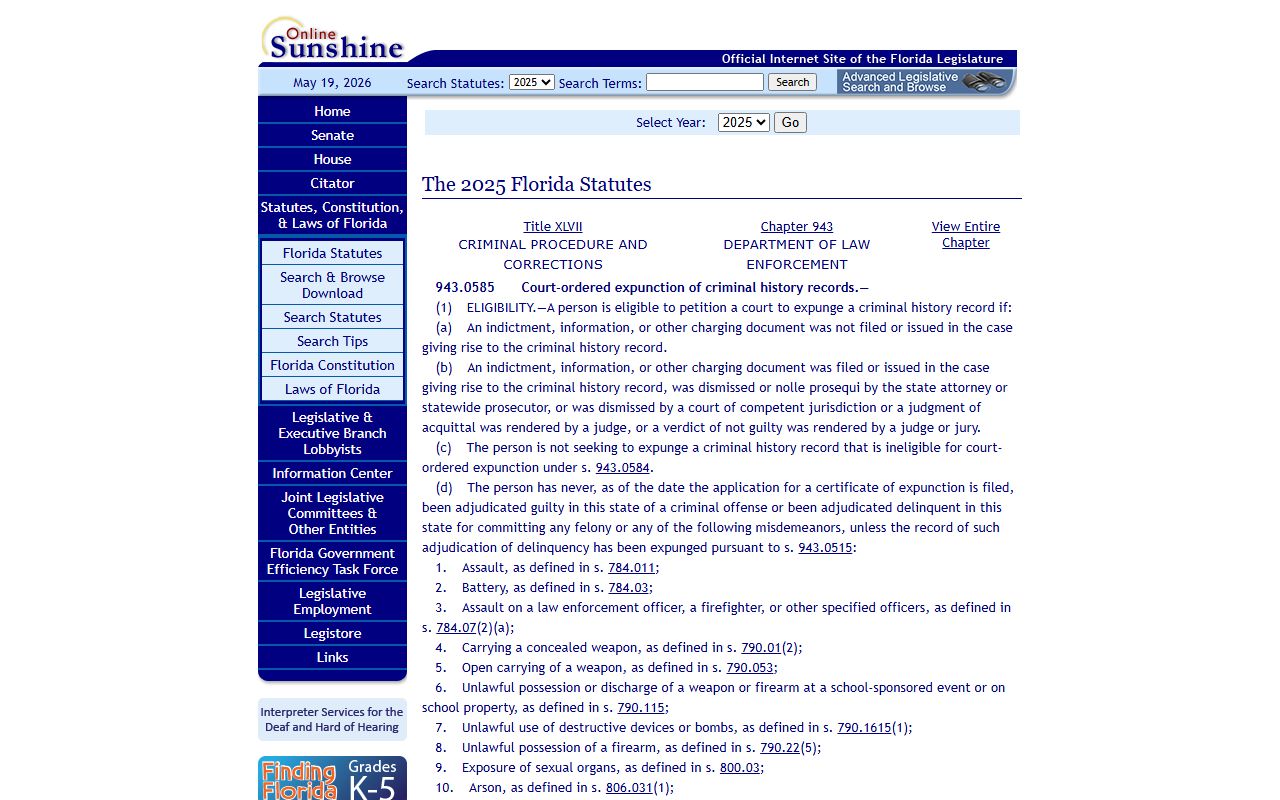
This statute governs who may petition for court-ordered expunction in Florida and what agencies must do after an order is granted.
The companion statute, F.S. 943.059 (sealing), is captured below.
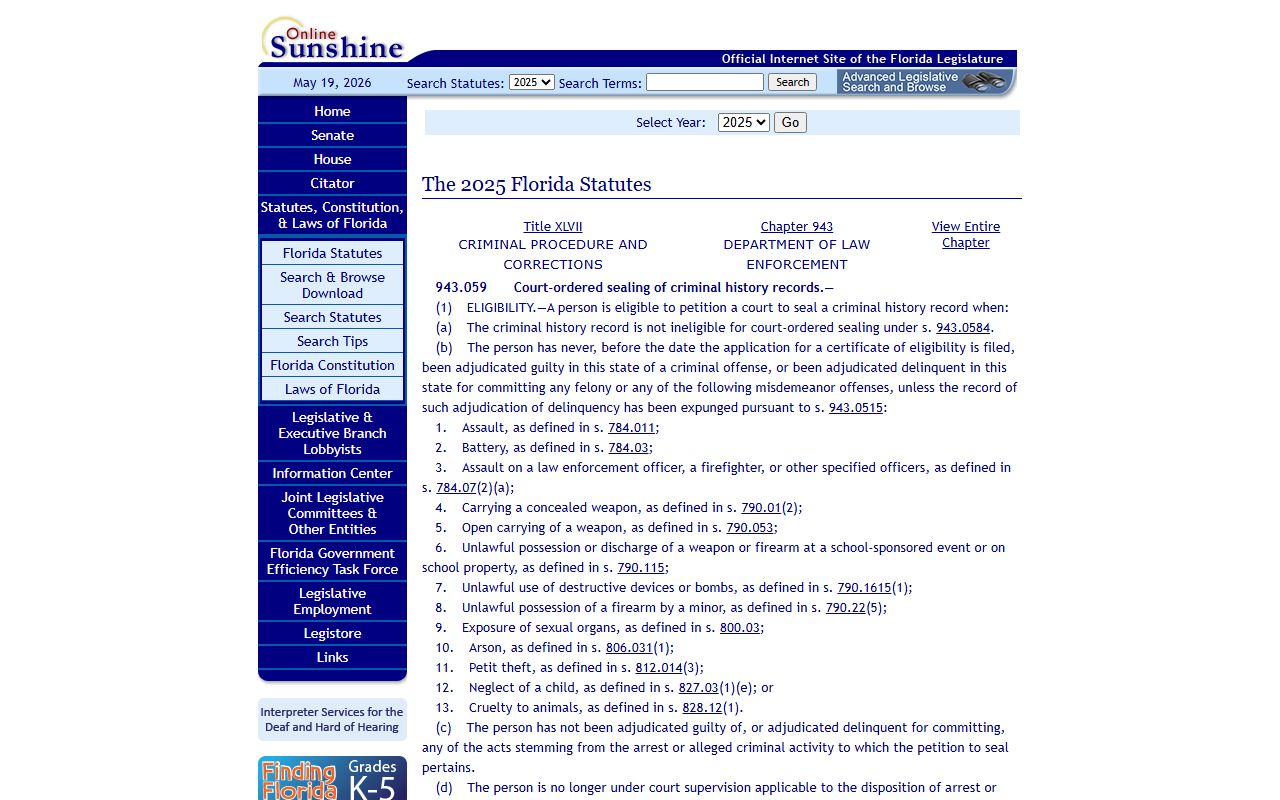
Sealing is available for a different subset of cases than expunction; reading both statutes carefully, or consulting the Public Defender or a private attorney, is the best way to determine which applies to a specific Collier County case.
Florida Statute Callout: Sealing and Expunction
Both statutes live in Florida Chapter 943, which covers criminal justice information. The two key sections are:
F.S. 943.0585 - Court-Ordered Expunction: Governs the destruction or removal of criminal history records from public access following a qualifying non-conviction outcome. FDLE must issue a Certificate of Eligibility before a court petition may proceed. After an order, agencies generally destroy or remove the record; FDLE retains a confidential file for limited statutory purposes. Read F.S. 943.0585.
F.S. 943.059 - Court-Ordered Sealing: Governs restriction of criminal history records from ordinary public access where adjudication was withheld or other statutory criteria are met. Sealed records still exist but are removed from ordinary public view. Certain agencies retain access under statute. Read F.S. 943.059.
Florida also has a juvenile criminal history record retention framework under F.S. 943.0515. Juvenile delinquency records are restricted by separate statutes and rules; the Clerk's portal shows Delinquency as a case category, but public internet access is suppressed for those records. See Collier County court records for more on what the Clerk's portal makes available to the public.
Collier County Warrants Overview
Active warrants in Collier County are searched through the same Sheriff portal as arrest records. Set the Type dropdown to WARRANT to focus only on warrant entries. All active warrants are searched with no date cutoff, unlike arrest records which go back only to January 1, 2016.
Types of warrants that may appear in Collier County records include arrest warrants issued after a probable cause determination, bench warrants or capias issued by a judge for a missed court date or contempt, and fugitive warrants where a "Hold For" agency or state is listed in the charges table of the arrest profile. Search warrants are generally not public before execution and do not appear in the Sheriff's public search tool.
If a warrant search shows a result, do not attempt to resolve it without legal advice. Call the Fugitive Warrants Bureau at 239-252-9655 to verify, and then contact an attorney or the Public Defender at pd20.org if you qualify for appointed counsel. The Clerk's ShowCase system can show the related court case number, current docket status, and any scheduled court events tied to the warrant matter. For a full walkthrough of warrant types and resolution steps, see Collier County warrant records.
Collier County State Attorney and Public Defender
Collier County criminal cases are prosecuted by the State Attorney for the Twentieth Judicial Circuit. The elected State Attorney is Amira Fox. The State Attorney's Office handles felony, misdemeanor, juvenile delinquency, and certain traffic and ordinance criminal cases for the circuit. The office website is sao20.org.
Indigent defendants in qualifying criminal, juvenile, and related proceedings may be represented by the Public Defender for the Twentieth Judicial Circuit. The elected Public Defender is Kathleen Smith. The office website is pd20.org. To request a public defender, a defendant must complete the application process in court. The Clerk's fee schedule lists the public defender application fee at $50. If the Public Defender has a conflict, the court may appoint conflict or registry counsel instead.
People who do not qualify for the Public Defender, or who need civil legal help, can contact Legal Aid Service of Collier County or Florida Rural Legal Services. The Florida Bar Lawyer Referral Service connects those who need a private attorney. The Twentieth Judicial Circuit also maintains a self-help center at the Naples courthouse at 3315 Tamiami Trail East, Suite 102, for pro se guidance.
Restricted Criminal Records in Collier County
Not every criminal matter in Collier County is open to the public. Several categories are restricted under Florida law and court rules, even when a case index entry may be visible in ShowCase or the Sheriff portal.
- Juvenile delinquency records: ShowCase lists Delinquency as a case type, but public internet access is suppressed. Separate juvenile statutes control disclosure.
- Sealed and expunged records: A court order under F.S. 943.0585 or 943.059 removes the record from ordinary public access. The Sheriff and Clerk systems may continue to show an entry until all agencies complete the required steps.
- Active law-enforcement investigative information: May be exempt while an investigation is open under Chapter 119 exemptions.
- Victim information: Crime-victim identifying and location information is protected in court and law-enforcement records under Florida's Marsy's Law framework and Chapter 119 exemptions.
- Mental health and Baker Act records: Mental health and substance-abuse involuntary treatment records are highly protected. Marchman Act court records are confidential under F.S. 397.6760.
- Adoption records: Adoption court records are confidential except to authorized persons or by court order under F.S. 63.162.
Florida's Security Matrix, governed by Florida Rule 2.420, controls what the Clerk's online portal makes publicly visible. Some records may appear in the case index but have documents or images withheld. A search result showing a case number does not always mean all associated filings are viewable online. Access to restricted records typically requires being a named party, having a court order, or visiting courthouse public terminals at 3315 Tamiami Trail East.