
How to Look Up Collier County Jail Population Data
Aggregate Collier County jail population data is not published in a live public dashboard on the Collier County Sheriff's Office website. The Sheriff's public-facing pages focus on individual arrest and warrant searches, not summary population counts. The most direct official proxy is the Sheriff's daily arrest report, which records bookings and in-custody status on any given date. That report is updated each day and is public. However, a single day's booking list is not the same as a headcount of everyone held in the jail on that date.
For aggregate population figures, the primary sources are: the Bureau of Justice Statistics Census of Jails, which surveys every jail in the United States on a periodic basis and publishes rated capacity, average daily population, admissions, demographics, and conviction status; and the BJS Jail Inmates statistical tables, which are released annually and allow users to compare Florida's county jail data against national figures. The Vera Institute of Crime and Justice has also published county-level incarceration trend data at its Incarceration Trends tool, though the Vera tool's county data for Collier was not directly accessible at the time this page was researched. The Collier County Sheriff's finance and budget page confirms the agency staffs and operates the jail system, which provides indirect budget context but does not publish headcount tables.
How to Read BJS Census of Jails Data
The BJS Census of Jails covers all local jails in the country and is the standard reference for county jail capacity and population comparisons. To use it for Collier County context:
- Go to bjs.ojp.gov/data-collection/census-jails-coj and open the most recent data year's tables.
- Look for the Florida state table or the facility-level appendix. Collier County entries appear under the Florida section, identified by facility name and jurisdiction.
- Find the columns for rated capacity, average daily population (ADP), and percent of capacity occupied. These three numbers show whether the jail is near or over its design limit.
- Check the admissions and releases columns. Annual admissions count how many people were booked, not how many were held at once; a high admission number with a low ADP means most people cycle through quickly.
- Review the conviction status table. BJS breaks jail populations into unconvicted (pretrial) and convicted (sentenced or awaiting transfer). This split is important for policy and legal analysis.
- Compare Collier's figures to Florida statewide averages and to the national rate per 100,000 residents to place local numbers in context.
Note: BJS data is released on a lag of roughly one to two years after the survey period. The figures reflect conditions as of the survey date, not today's headcount.
Collier County Jail Capacity Overview
The Collier County Sheriff's Office operates two jail facilities. The Naples Jail Center is the primary booking and custody location. The Immokalee Jail Center is a secondary facility serving the eastern part of the county. The Sheriff's public pages and finance materials confirm both facilities are staffed and operated by the Sheriff's Corrections Department, but official rated bed capacity figures were not published on Sheriff web pages during the research for this page. The table below reflects the addresses and contact numbers confirmed from official Sheriff sources, with the capacity cells marked to show the research gap clearly.
| Facility | Address | Phone | Rated Capacity |
|---|---|---|---|
| Naples Jail Center | 3347 Tamiami Trail East, Naples, FL 34112 | 239-252-9504 | Not located in official Sheriff pages; see BJS Census of Jails for survey-year figure. |
| Immokalee Jail Center | 302 Stockade Road, Immokalee, FL 34142 | 239-252-9735 | Not located in official Sheriff pages; see BJS Census of Jails for survey-year figure. |
Anyone needing the current official bed count should contact the Sheriff's Corrections Department directly, request the figure through a public-records request under Florida Statute 119, or consult the most recent BJS Census of Jails report. The Sheriff's finance page notes the agency employs more than 1,300 total members, with roughly 80 percent of the agency budget covering salaries and benefits, which reflects a large correctional workforce consistent with operating two facilities.
Average Daily Population
Average daily population, or ADP, measures how many people are held in a jail on a typical day over the course of a year. It is calculated by dividing total person-days of custody by the number of days in the year. ADP is different from admissions: a jail can book thousands of people annually while keeping a relatively low ADP if most bookings result in quick release on bond or own recognizance. Conversely, a jail holding many pretrial detainees for long periods can show a high ADP even with moderate booking numbers.
A specific Collier County ADP figure was not located in Sheriff public pages during research for this page. The Sheriff's daily arrest report for May 18, 2026, showed 17 arrest entries, with some marked IN CUSTODY and others showing bonded status. That figure is a daily booking report, not the jail headcount, and should not be used as ADP. The BJS Jail Inmates annual statistical tables provide the most reliable ADP figure for Collier County, derived from the Bureau's annual jail survey. The most recent published year in the BJS statistical tables series is the 2023 edition. Users researching Collier-specific ADP should consult the BJS facility-level data or the Florida Department of Corrections statistical reports for the most current available figure.
Florida as a whole has historically maintained a jail incarceration rate below the national average, though individual county rates vary significantly based on local policy, bond practices, and case volume. Collier County's relatively affluent coastal demographics coexist with an Immokalee agricultural labor population that can create distinct justice-system patterns not visible in county-wide averages.
Demographic Breakdown
Collier-specific demographic data for the jail population was not located in publicly accessible Sheriff reports during research. The BJS Census of Jails collects sex, race, Hispanic or Latino origin, citizenship status, and juvenile status for each surveyed facility, and those figures appear in the national and state-level tables. Florida-level demographic data from BJS shows that male inmates make up the large majority of the state's jail population, consistent with national patterns where roughly 85 percent of jail inmates are male. Hispanic and Latino inmates are overrepresented nationally relative to general population share, a pattern particularly relevant for Collier County given the significant Latin American agricultural workforce centered in Immokalee.
| Demographic Group | National Jail Average (BJS 2023) | Collier County Specific Data |
|---|---|---|
| Male | Approx. 85% | Not published in Sheriff pages; request via public-records process |
| Female | Approx. 15% | Not published in Sheriff pages; request via public-records process |
| White (non-Hispanic) | Approx. 50% (national) | Not published in Sheriff pages |
| Black or African American | Approx. 34% (national) | Not published in Sheriff pages |
| Hispanic or Latino | Approx. 15% (national) | Not published; may be higher locally given county demographics |
The national figures above come from BJS Jail Inmates 2023 statistical tables and are provided to give a comparison baseline. Collier County's actual breakdown requires either a public-records request to the Sheriff or a review of the county's entry in the BJS facility-level data. Demographic patterns in local jails can differ sharply from statewide or national averages, so applying national figures to Collier without county-specific confirmation would be misleading.
Pretrial vs. Sentenced Population
The pretrial/sentenced split is one of the most important data points for understanding a county jail. Pretrial inmates have not been convicted; they are held because they could not make bail, were denied bond, or are awaiting case resolution. Sentenced inmates are serving a term after conviction or plea, typically misdemeanor sentences or short felony terms. Federal or state prison-sentenced individuals are usually transferred out of county jail once they begin serving longer sentences, so county jails hold a mix of pretrial detainees and locally sentenced people. High pretrial populations often reflect restrictive bond practices or high rates of financial inability to post bail.
| Population Status | Collier County Specific Figure | National Average (BJS 2023) |
|---|---|---|
| Unconvicted / Pretrial | Not located in Sheriff public pages | Approx. 67% of jail population nationally |
| Convicted / Sentenced | Not located in Sheriff public pages | Approx. 33% of jail population nationally |
National data from the BJS Jail Inmates 2023 statistical tables shows that roughly two-thirds of people in local jails on any given day are unconvicted, meaning they are awaiting trial or other resolution rather than serving a sentence. Florida's pretrial share tends to track near the national figure. Collier County's Circuit Court handles bond hearings; the Clerk's ShowCase court case search shows bond status fields and first-appearance docket entries for individual cases. Checking whether a specific person posted bond requires a case search rather than a population summary.
Note: Bond status in the Sheriff's daily arrest report uses values such as BONDED with date and "No information available," which can indicate release from custody or pending bond determination, respectively.
Misdemeanor vs. Felony Population
Collier County jails hold people charged with or convicted of both misdemeanors and felonies. The distinction matters because misdemeanor sentences are typically served locally, while felony sentences often result in transfer to the Florida Department of Corrections state prison system after sentencing. The Collier Clerk's ShowCase case portal categories include Felony, Misdemeanor, Criminal Traffic, and Non-Reporting Criminal, giving a sense of the charge landscape flowing through the court, though those case counts are not the same as the jail population count.
A Collier-specific misdemeanor-versus-felony breakdown for the jail population was not located in Sheriff public pages during research. The Sheriff's daily arrest report for May 18, 2026 showed examples of both misdemeanor charges (open container, driving without a valid license) and felony-level charges (DUI, hit and run, reckless driving) among people booked and marked IN CUSTODY on that date. Those booking-level charge categories give a qualitative sense of the charge mix but are not a population percentage. For exact figures, a public-records request to the Collier County Sheriff's Corrections Department is the direct path. The BJS Census of Jails does not break down facility populations by charge level in its standard published tables.
Mental Health and Medical Population
The Collier County Sheriff's Office has a documented relationship with the David Lawrence Centers for behavioral health, and the Sheriff's biography mentions Mental Health Court, Crisis Intervention Training, Baker Act referrals, Marchman Act referrals, Law Enforcement Assisted Diversion, and forensic intensive reintegration services as active programs. These programs interact directly with the jail population: Baker Act and Marchman Act holds can bring people into law enforcement custody who may then transition to a mental health or substance-use treatment track rather than a standard criminal case. The Twentieth Judicial Circuit also operates Mental Health Court and Drug Court for eligible defendants, which can divert people out of the standard custody pipeline.
A specific percentage of Collier County jail inmates receiving mental health or medical care was not located in Sheriff public pages. Nationally, the BJS Jail Inmates survey has found that a significant share of jail populations report mental health conditions, with some estimates ranging from 20 to 44 percent depending on the measurement used. Medical care in the Collier jail is the responsibility of the Sheriff's Corrections Department; the Sheriff's finance page confirms jail staffing as a core budget item but does not break out medical staffing separately in publicly available summaries. People seeking information on a specific individual's medical needs while in custody should contact the Naples Jail Center at 239-252-9504 or file a written request.
National and State Context (BJS)
The Bureau of Justice Statistics publishes annual jail population data covering every state and, in survey years, every individual jail facility. The most recent annual statistical tables, covering 2023, put the national jail incarceration rate at roughly 217 per 100,000 U.S. residents. Florida's rate has historically run below the national average. A precise Collier County rate per 100,000 residents was not located in official sources during research; the table below uses the national and Florida-approximate figures to frame the comparison, and the Collier cell is marked as a research gap.
The BJS Jail Inmates 2023 statistical tables are the authoritative source for these rates. They are published by the U.S. Department of Justice and updated annually. Florida-level figures are drawn from the same BJS data series. Collier County's rate would need to be calculated using county population estimates from the U.S. Census Bureau and the county's actual jail population from BJS or Sheriff sources.
| Level | Jail Population per 100,000 Residents | Source |
|---|---|---|
| Collier County | Not located in official sources; calculate from BJS facility data and Census population | BJS Census of Jails + U.S. Census Bureau |
| Florida (statewide) | Below national average; exact figure from BJS state tables | BJS Jail Inmates 2023 statistical tables |
| National | Approx. 217 per 100,000 | BJS Jail Inmates 2023 statistical tables |
The BJS Census of Jails is conducted periodically and collects facility-level data separate from the annual report. The most recent full census provides rated capacity, ADP, admissions, staffing, and program data at the individual jail level. Researchers who want Collier-specific numbers should pull the Florida facility appendix from the census year that best matches their research period. The BJS data collection page lists all available data files and methodology documentation.
The image below is from the BJS Census of Jails data collection page, which serves as the primary national reference for local jail population, capacity, and demographic statistics.
The Bureau of Justice Statistics Census of Jails is the standard reference for comparing Collier County jail data against state and national benchmarks.
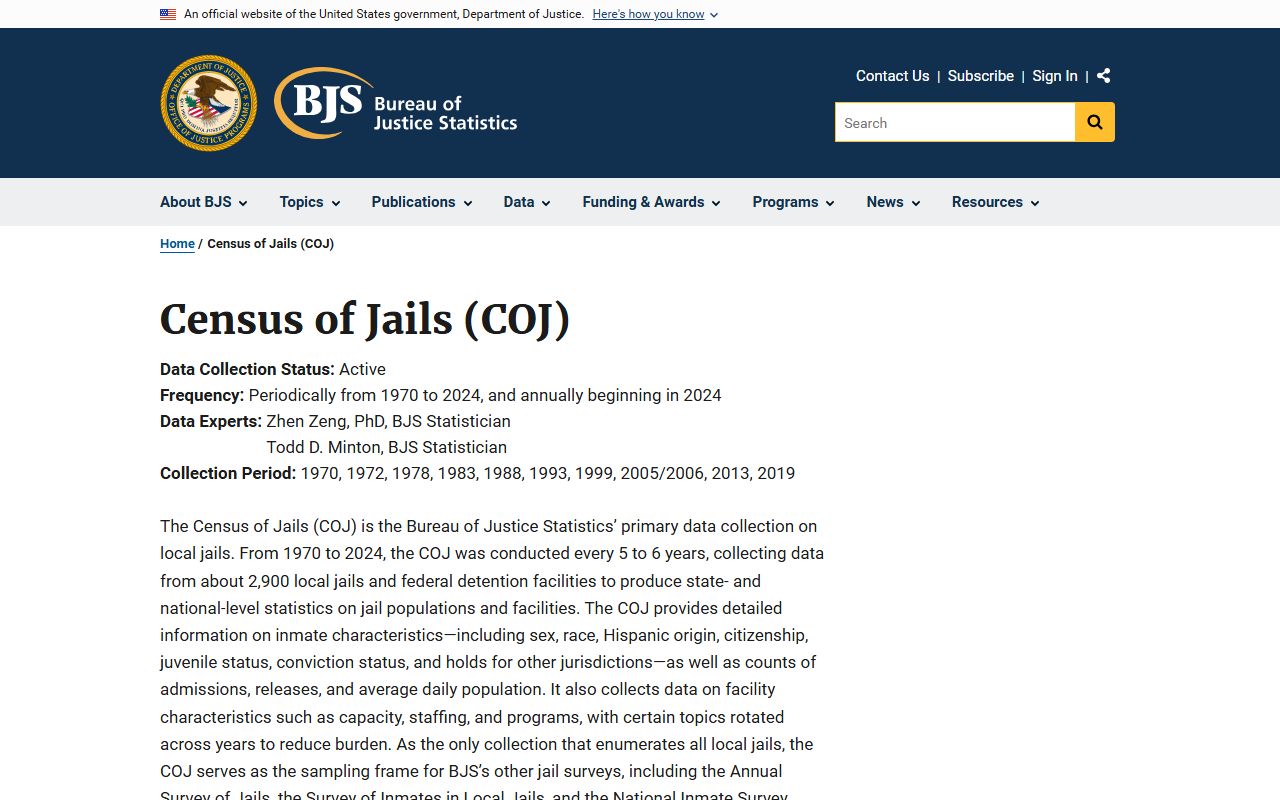
The BJS Census of Jails collects rated capacity, average daily population, admissions, demographics, and conviction status for every local jail in the country, including Florida's county-operated facilities.
Population Trends Over Time
Collier County has grown rapidly since the mid-twentieth century, with population surging from a small coastal and agricultural base to one of Florida's more populous counties. Court and jail caseloads tend to track population growth, though local policy choices around arrest, diversion, and bond can cause the jail population to grow faster or slower than general population trends. The Sheriff's 2025 and 2026 budget context shows an agency of more than 1,300 members, which is a substantially larger correctional workforce than would be needed for a small or static jail population.
Nationally, the BJS data shows that U.S. jail populations fell sharply during the COVID-19 pandemic in 2020, then began recovering in 2021 and 2022, with most jurisdictions still below their pre-2020 peaks as of 2023. Florida followed a similar pattern. Whether Collier County's jail population followed this national arc, recovered faster, or remained lower depends on local Sheriff policies, court operations, and diversion program capacity. Multi-year trend data for Collier would come from the BJS annual jail surveys or a public-records request to the Sheriff for annual population reports.
The Vera Institute of Crime and Justice has published county-level incarceration trend data through its Incarceration Trends tool, which draws on BJS and Census Bureau data to graph jail and prison populations at the county level over multiple decades. The Vera tool was not accessible at the time of research, but it can be a useful supplement to BJS tables when county-level historical trend lines are needed. Vera data is particularly useful for comparing Collier's long-run trajectory against similar counties in Florida and against the national trend line.
The image below is from the BJS Jail Inmates 2023 statistical tables page, which provides the most recent annual data on jail population trends nationally and by state.
BJS Jail Inmates 2023 Statistical Tables provide national and state-level jail population data that can frame Collier County trend analysis.
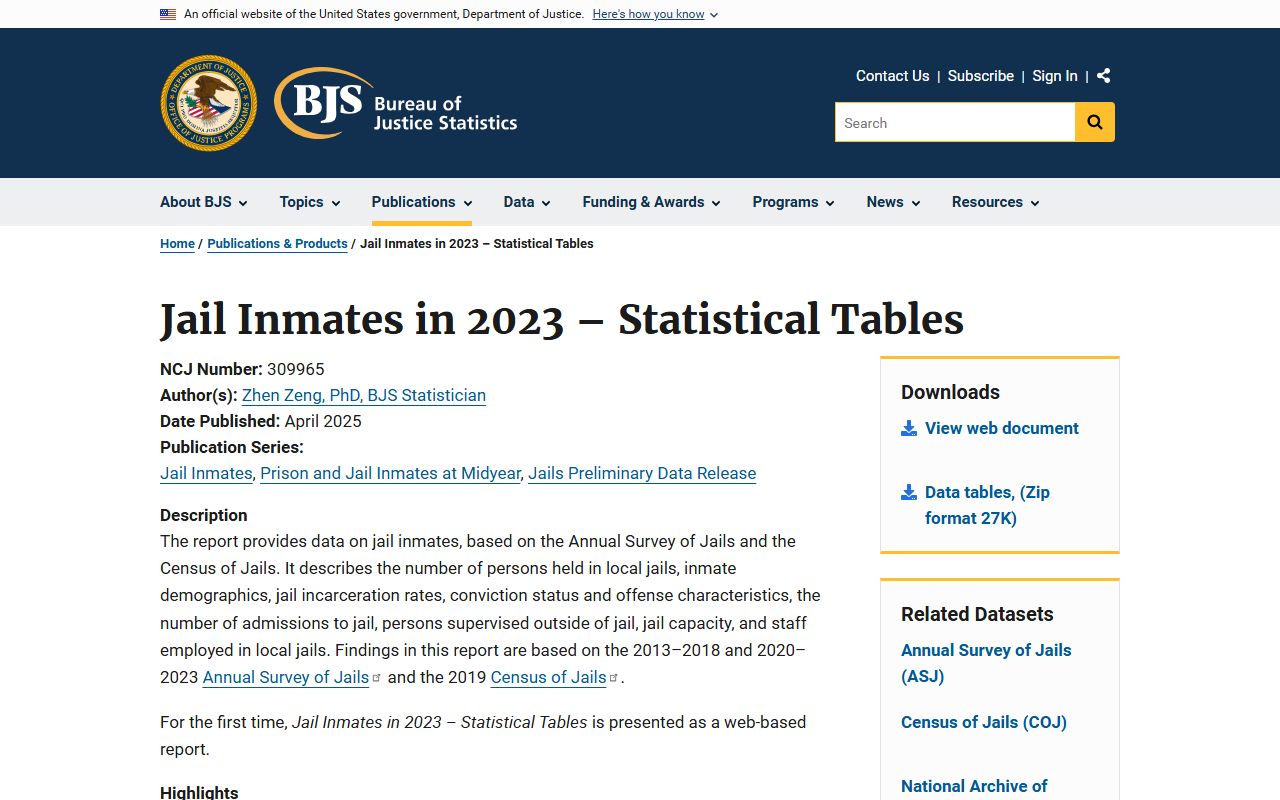
Annual BJS jail inmate tables track admissions, ADP, and conviction status trends that allow researchers to place Collier County's jail population in multi-year context against Florida and national figures.
Searching for Collier County Inmate Records by Name
The data on this page covers aggregate jail population statistics, facility capacity, demographic context, and national comparisons. For individual name-based lookups of people currently or recently held in the Collier County jail, use the Collier County inmate records search, which links to the Sheriff's active arrest and warrant portal and explains the search fields, result fields, and custody status indicators in detail. The Sheriff's arrest search covers records from January 1, 2016, forward and all active warrants; it returns up to 100 results per query and requires accepting a terms screen before searching.
Where the Data Comes From
Three layers of sources inform Collier County jail population data. The first is the Collier County Sheriff's Office itself. The Sheriff's public website provides daily arrest reports, individual arrest and warrant search results, and budget/finance pages. The finance page confirms the Sheriff operates the jail with a staff of more than 1,300 members. The Sheriff does not publish a live population dashboard or an official bed-capacity figure on public-facing web pages as of the research date for this page.
The second layer is the Bureau of Justice Statistics. BJS conducts the annual Jail Inmates survey and the periodic Census of Jails. These are federal government surveys of local jails and are the definitive national source for rated capacity, ADP, admissions, releases, demographic breakdowns, and conviction status at the county level. BJS data carries a lag of one to two years. It is published by the U.S. Department of Justice, Office of Justice Programs.
The third layer is supplementary: the Vera Institute's Incarceration Trends tool, which synthesizes BJS and Census data into county-level charts, and Florida Department of Corrections statistics for people who have moved from local jail to state prison custody. For individual cases, the Collier Clerk ShowCase Web case portal shows court-side data including bond status, charge categories, and case disposition, while the Florida DOC offender search covers state-sentenced individuals no longer held in Collier facilities.
The image below is from the Collier Sheriff's arrest search portal, which shows today's arrests and is one of the primary official sources for real-time custody information at the individual level.
The Collier Sheriff's Today's Arrests report shows daily booking entries with in-custody flags and bond status, offering a real-time snapshot of recent bookings though not a full jail population count.
The Sheriff's daily arrest report lists each booking with an IN CUSTODY flag or bond status, which provides individual-level custody information but is not a substitute for an aggregate jail population count or an official capacity figure.